
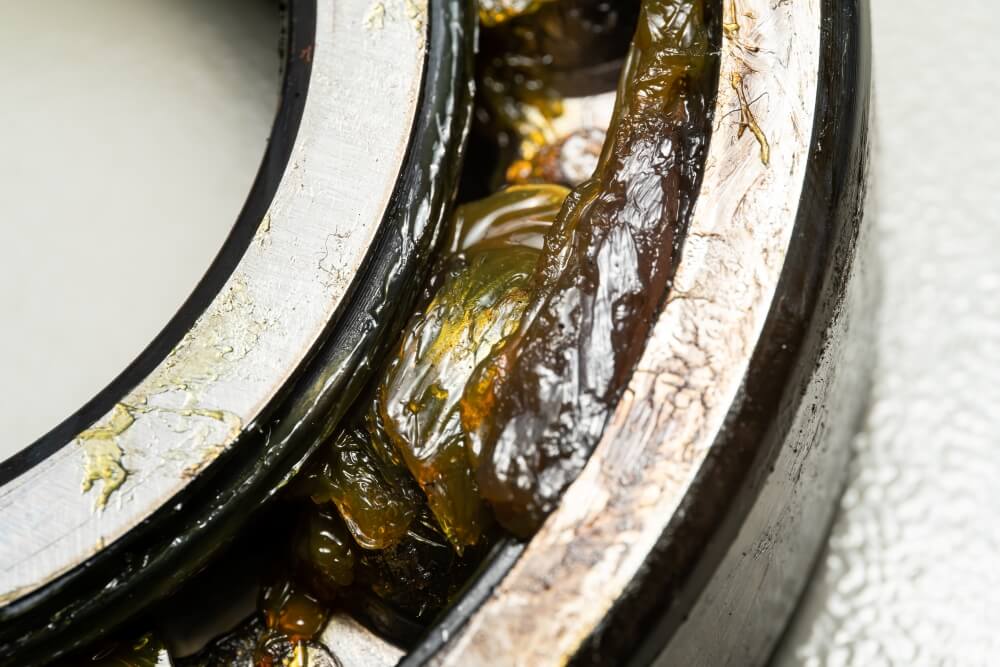
A grease can have the right base oil, thickener and additives, yet still cause problems because its consistency does not suit the application.
Too firm, and it may resist pumping through a centralised system or fail to move properly into the contact zone. Too soft, and it may leak past seals or move away from the point that needs lubrication. The NLGI grade helps describe this difference, but it should never be read as a quality rating.
This guide explains NLGI grease grades: what the numbers measure, how consistency affects equipment and what should be checked before changing grades.
What Does an NLGI Grease Grade Mean?
NLGI grades describe the consistency of lubricating grease, from semi-fluid grades at the lower end of the scale to very firm grades at the upper end.
The scale runs from NLGI 000 to NLGI 6. Lower numbers identify softer greases. Higher numbers identify firmer ones.
NLGI 2 sits around the middle and is commonly specified for automotive chassis points, wheel bearings and general industrial bearing applications. That familiarity can make it an easy default, but it is not a universal choice. A centralised system, for example, may need a softer product that can travel through narrow lines, particularly during cold starts.
The difference between NLGI 1 and NLGI 2 grease is therefore more than a small change on a specification sheet. It can affect how readily the grease reaches the component and how well it stays there once applied.
How Are NLGI Grades Determined?
Grease consistency is commonly assessed using cone penetration testing under ASTM D217 grease testing procedures.
A standard cone is allowed to penetrate a prepared grease sample under controlled conditions. The depth is measured in tenths of a millimetre. Greater penetration means the sample is softer; less penetration means it is firmer.
The measured worked-penetration range is then used to assign an NLGI grade. ASTM D217 covers the full range from NLGI 000 to NLGI 6.
This test answers one specific question: how firm is the grease under the test conditions?
It does not establish the grease’s load-carrying capacity, resistance to water, oxidation stability, corrosion protection or expected service life. Two greases can share the same NLGI grade and perform very differently because their base oils, thickeners and additive packages are different.
NLGI Grade Chart and Typical Applications
| NLGI grade | General consistency | Typical application examples |
| 000 | Very fluid | Enclosed gears and some centralised lubrication systems |
| 00 | Semi-fluid | Gearboxes and systems requiring easy movement through lines |
| 0 | Very soft | Centralised systems and some low-temperature applications |
| 1 | Soft | Pumped systems, cold conditions and selected high-speed bearings |
| 2 | Medium | General-purpose bearings, chassis points and many automotive applications |
| 3 | Firm | Applications requiring greater resistance to leakage |
| 4–6 | Very firm to hard | Specialised sealing, blocking and low-movement applications |
How Does NLGI Grade Affect Grease Performance?
1. Pumpability and distribution
Softer grease usually moves through pumps and distribution lines more readily than a firmer grade. This becomes especially relevant when lines are long, pipe diameters are small or the equipment must start in low ambient temperatures.
A grease that creates too much resistance may not reach every lubrication point in the required quantity. A system can appear to be operating while a remote bearing receives little or no fresh lubricant.
Pumpability is not determined by the NLGI number alone, however. System pressure, line dimensions, temperature and the grease formulation also matter. Equipment and product data should be checked before a grade is changed.
2. Leakage and retention
Moving to a firmer grade can appear to be an obvious response when grease leaks from a bearing or housing. Sometimes it helps. Sometimes it hides a worn seal, excessive fill volume or another mechanical problem.
A grease must be firm enough to remain where it is needed, but mobile enough to replenish the contact zone as the component operates. The grease consistency for bearing lubrication should be assessed alongside bearing type, speed, clearances and relubrication method.
Using a harder grease to compensate for leakage without investigating the cause may reduce lubricant movement inside the bearing.
3. Temperature and equipment design
Grease generally becomes more resistant to movement as temperature falls and softer as temperature rises. That change can affect pumping, channelling and leakage.
Cold starts are particularly demanding for centralised systems. At the other end of the range, elevated operating temperatures may require more than a firmer NLGI grade. Thickener stability, base-oil viscosity, oxidation resistance and dropping point may all need attention.
Mining and heavy-industry applications add dust, water, shock loading and long supply lines to the selection process.
LSA Oils discusses those conditions on lubrication support for Australian mining operations.
Which NLGI Grade Should You Choose?
Start with the equipment manufacturer’s lubrication specification. It may nominate more than an NLGI grade, including the required base-oil viscosity, thickener type, operating range or performance classification.
Before substituting a grease, check:
- How the product is applied, including whether it is manually greased or centrally pumped;
- The lowest start-up temperature and normal operating temperature;
- Component speed, load, vibration and exposure to water;
- Seal condition and any history of leakage;
- Compatibility with the grease already in the component.
The correct grease grade for a central lubrication system is often softer than a general-purpose bearing grease, but the system designer or equipment manufacturer should confirm the grade. Pump design and line length can change what will work reliably.
Compatibility needs the same care. Mixing products with different thickener systems can alter consistency or affect performance. The existing grease should be identified before another product is introduced. The guide to choosing automotive lubricants in Australia provides further context on consistency, thickener chemistry and product selection.
Frequently Asked Questions About NLGI Grades
Is a higher NLGI grade better?
No. A higher grade means the grease has a firmer consistency. It does not indicate better wear protection, higher load capacity or longer service life.
Are all NLGI 2 greases interchangeable?
No. They may have comparable consistency while using different base oils, thickeners and additives. Temperature capability, water resistance, compatibility and load performance can vary considerably.
What NLGI grade is commonly used for wheel bearings?
NLGI 2 is commonly used in many automotive wheel-bearing applications. The vehicle, bearing or equipment manufacturer’s specification should still be checked, as application requirements differ.
Can NLGI 1 grease replace NLGI 2?
Only when the equipment specification or qualified technical advice permits the change. NLGI 1 may pump more readily, especially in colder conditions, but it may also be less resistant to leakage.
Does NLGI grade indicate grease viscosity?
No. NLGI grade describes the consistency of the finished grease. Base-oil viscosity is a separate property and influences lubricant-film formation under operating speed, temperature and load.
The Grade Is Only One Part of the Specification
An NLGI number is useful because it narrows down consistency. It does not finish the selection process.
Check the manufacturer’s recommendation, application method, temperature range and existing product before changing grease. Then compare the relevant NLGI grades and complete grease specifications rather than relying on consistency alone.
