
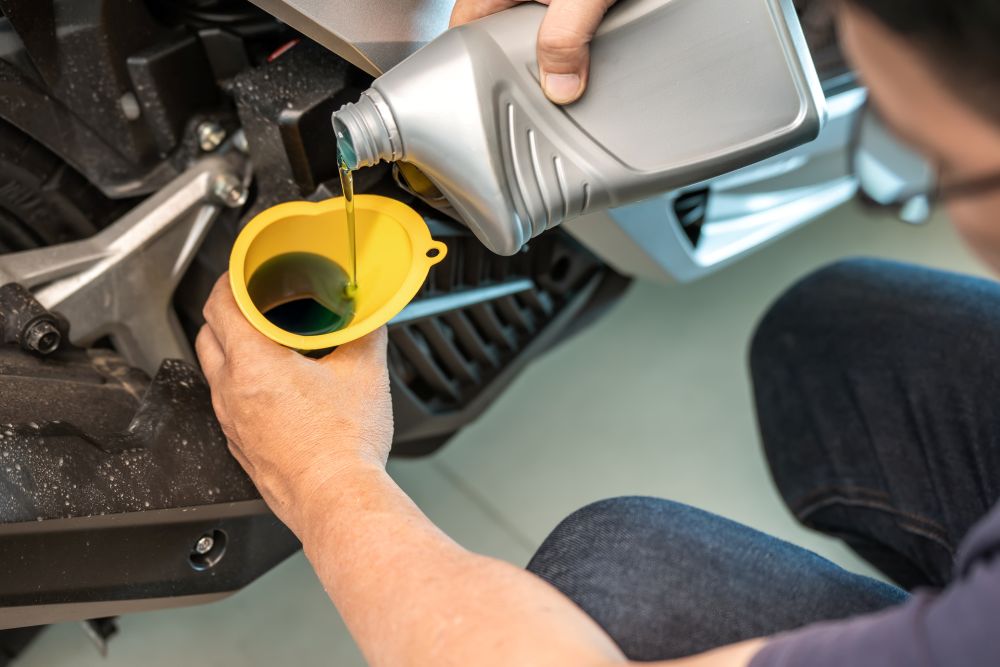
A gearbox doesn’t get much sympathy. It deals with heat, load, stop-start driving, towing, and the occasional heavy right foot, all while trying to shift cleanly and protect expensive internals. When people talk about “changing the gearbox oil”, they often mean different things, because the fluid inside an automatic performs a different role to the oil in many manuals.
That’s why transmission fluid types matter. The right choice supports smooth shifting and wear control. The wrong choice can lead to shudder, delayed engagement, noisy operation, or accelerated component wear.
What the fluid actually does in an automatic
Automatic gearbox internals rely on oil pressure and friction control
Automatics and powershift transmissions use fluid as a working medium. It carries hydraulic pressure through valves and passages, lubricates bearings and gears, and manages friction inside clutch packs. These roles require a tightly controlled additive package and stable performance across temperature changes.
LSA Oils describes its range as built for long-lasting protection and smooth gear changes in diverse Australian conditions, with formulations suited to heavy-duty demands while improving efficiency and reducing wear.
Automatic transmission fluids and where ATF III fits
Automatic transmission fluids is not just “red oil that makes gears slippery”. It behaves more like a hydraulic fluid with carefully tuned friction characteristics. For older vehicles, LSA Oils ATF III is designed around Dexron and Mercon-style requirements and suits older-generation applications in automatic transmissions and power steering systems where those fluids are specified.
ATF III is formulated to the Dexron IIIH standard and is described as offering thermal stability, smoother gear shifts, and extended service life under demanding operating conditions. It is dyed red for easier leak detection and is positioned as compatible with earlier Dexron and Mercon-type fluids for top-ups or full changes.
Modern autos: why “service fill” matters
Modern automatics often run different calibrations and clutch materials compared to early 2000s units, so they require a different approach to friction control and high-temperature stability. LSA Oils ATF Multitrans HV is positioned as a premium synthetic automatic transmission and power steering fluid, described as a service fill fluid for modern automatic transmissions. It uses synthetic base oils and additives for thermal stability, friction control, load-carrying capacity, and corrosion and wear protection.
In practical terms, this means a modern ATF must maintain its viscosity and friction behaviour over time. If it shears down or oxidises early, shift quality can decline and heat can increase, especially in vehicles that do short trips, tow, or spend time in traffic.
Manual gearboxes: gear teeth, synchronisers, and different priorities
Many manual gearboxes rely on oil film strength between gear teeth and bearings, along with suitable friction characteristics for synchronisers. Some designs use a dedicated manual gearbox oil, while others specify an ATF-style fluid. Either way, the handbook specification matters more than the colour in the bottle.
Manual gearbox oils typically focus on protecting gears and bearings under load. Too thick can result in poor cold shifting; too thin can reduce film strength when the gearbox is hot. The “best” oil is the one that matches the gearbox design and manufacturer requirements.
Heavy-duty manuals and Road Ranger gearboxes: Transfluid SYN 50
Some heavy-duty manual transmissions, including Road Ranger gearboxes, require SAE 50-style oils where extreme pressure chemistry is not needed. LSA Oils Transfluid SYN 50 is described as a premium synthetic oil for Road Ranger gearboxes and for automotive and industrial applications where EP properties aren’t required. It also highlights a high viscosity index and low pour point to maintain a protective film for gear teeth and bearings.
This “film strength plus stability” approach suits applications with sustained load and heat, where weak oil films can lead to noisy bearings and accelerated wear.
Not every “automatic” is the same gearbox
A quick check before topping up is essential. Traditional torque-converter automatics, CVTs, and dual-clutch transmissions require different fluid chemistries. LSA Oils states that ATF III is not recommended for CVT or DCT systems, reinforcing the importance of matching the fluid to the transmission design to avoid costly mistakes.
If your vehicle uses a CVT, a CVT-specific product is required. LSA Oils lists ATF CVT 100 as a fully synthetic continuously variable transmission fluid.
A quick guide to picking the right LSA Oils product
The goal is to match the gearbox requirement to a product that meets it, not to “upgrade” through guesswork. LSA Oils highlights benefits across its range, including smooth and reliable shifting, options designed to improve fuel efficiency, and protection under demanding operating conditions.
Here’s a simple way to approach selection within the LSA Oils range:
| Issue | Typical Cause | What Happens |
|---|---|---|
| Oil too thin | High ambient temp or wrong grade | Internal leakage, film breakdown, wear |
| Oil too thick | Cold start or wrong grade | Cavitation, sluggish response, power loss |
| Viscosity breakdown | Heat or shear forces | Loss of film strength, accelerated wear |
Practical checks that prevent repeat problems
A fluid change can resolve symptoms, but may also reveal underlying issues. If the old oil smells burnt, appears unusually dark, or contains metallic particles, treat this as a prompt for further inspection rather than a completed job.
A few habits help reduce repeat issues:
- Keep top-ups conservative. Overfilling can aerate oil and affect shift quality.
- Avoid mixing products unless compatibility with the required specification is confirmed.
- Treat power steering systems with the same care, as both ATF III and ATF Multitrans HV are also suitable for power steering in appropriate applications.
- Record what was used and why. This makes future servicing faster and helps when multiple vehicles share workshop stock.
Where transmission fluids fit in real workshop life
Workshops and owners generally want consistent servicing with smooth, predictable shifts. The simplest way to achieve this is by matching the correct product to the gearbox, then maintaining that choice. LSA Oils’ transmission range is built around this approach, covering older ATF requirements, modern service fill applications, and heavy-duty manual uses such as Road Ranger gearboxes.
