
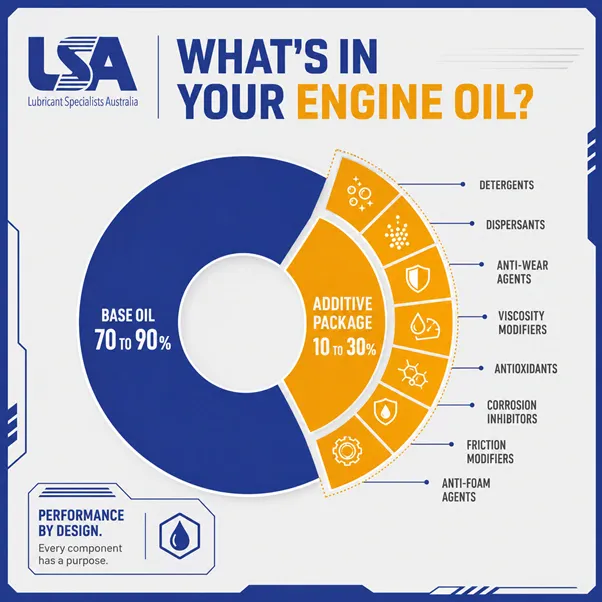
Pour a litre of engine oil into your hand and you might assume you are looking at a single substance. You are not. What you are holding is a carefully engineered blend, and the base oil itself typically makes up only 70 to 90 per cent of it. The remainder is an additive package, a cocktail of chemical compounds that does much of the work people credit to the oil itself. Understanding what those additives do, and why their balance matters, is one of the most useful things any vehicle owner or fleet operator can learn.
Why Additives Exist at All
Base oil, whether mineral or synthetic, is good at one thing: creating a lubricating film between moving parts. Left to its own devices, however, it struggles with almost everything else an engine throws at it. It oxidises when hot. It thins when temperatures climb and thickens when they fall. It cannot neutralise the acids produced by combustion, and it has no way of dealing with the soot, varnish and sludge that accumulate over thousands of kilometres.
Additives exist to fill those gaps. Formulators begin with a base oil and then build a package around it, with each component assigned a specific job. The result is a finished lubricant that behaves in ways raw oil never could.
The Main Additive Families
Detergents work on the hottest surfaces of the engine, particularly around the pistons. They neutralise the acidic by-products of combustion and prevent deposits from baking onto metal. Without them, piston rings would stick and high-temperature varnish would build steadily.
Dispersants handle the debris that detergents cannot. Their job is to surround soot particles and sludge precursors, keeping them suspended in the oil rather than letting them settle in galleries or clump on surfaces. This matters enormously in diesel engine oils, where soot loading is a constant challenge, and it is one reason heavy-duty formulations carry such robust dispersant levels.
Anti-wear agents, most famously zinc dialkyldithiophosphate, or ZDDP, act as a sacrificial layer. Under extreme pressure, where the oil film alone cannot keep metal from touching metal, these compounds bond to surfaces and wear away in place of the components they protect. Camshafts, lifters and piston rings owe much of their service life to this chemistry.
Viscosity index improvers are long polymer chains that expand as the oil heats up, countering its natural tendency to thin. They are the reason a modern multigrade oil can flow at a cold start in an alpine winter and still hold a protective film in an Australian summer.
Antioxidants slow the rate at which oil reacts with oxygen at high temperature. Oxidation thickens oil, creates acids and shortens its life, so antioxidants are what make extended drain intervals possible.
Corrosion and rust inhibitors form a protective barrier on ferrous and non-ferrous metals alike, guarding bearings and internal surfaces against moisture and acidic attack. Rounding out the package, friction modifiers trim fuel consumption, and anti-foam agents stop the oil from whipping into bubbles that would collapse its load-carrying film.
The Balance Matters More Than the Ingredients
It is tempting to conclude that if additives are good, more must be better. The opposite is closer to the truth. Additive packages are engineered as a whole, and the components interact. Too much ZDDP can poison catalytic converters and diesel particulate filters, which is why modern low-SAPS oils deliberately restrict it. Too much detergent can interfere with anti-wear films.
This is precisely why industry specifications exist. Bodies such as the American Petroleum Institute define service categories that a finished oil must pass rigorous testing to claim, and manufacturers nominate those categories in the owner’s handbook. It is also why pouring an aftermarket additive into a properly formulated oil is usually a step backwards. You are not topping up the protection; you are unbalancing a recipe that took a laboratory years to perfect. Choosing high-performance lubricants blended to the correct specification does the job the way it was designed to be done.
Choosing the Right Additive Package
The practical advice is straightforward. Match the specification in your handbook, not the marketing on the bottle. A vehicle that calls for an ACEA C3, DPF-safe oil needs the mid-SAPS additive chemistry of a product like Eco Universal 5W30, while older machinery may be better served by a full-SAPS formulation. Suppliers of engine oils and automotive lubricants Australia wide publish these specifications on every product data sheet, so the information is never far away.
Get the Right Oil the First Time
At LSA Oils, we have spent three decades helping Australians match the right lubricant to the right machine. As a trusted lubricants distributor with stockists across the country, we formulate every product to meet the industry and OEM specifications your equipment demands. Try our Lube Guide to find your match in minutes, or visit your nearest engine oil supplier Australia wide through our store locator. Our technical team is always ready to help you choose with confidence.
